



Narcissus obvallaris (Tenby Daffodil) - Native Welsh Daffodil for Spring Naturalising
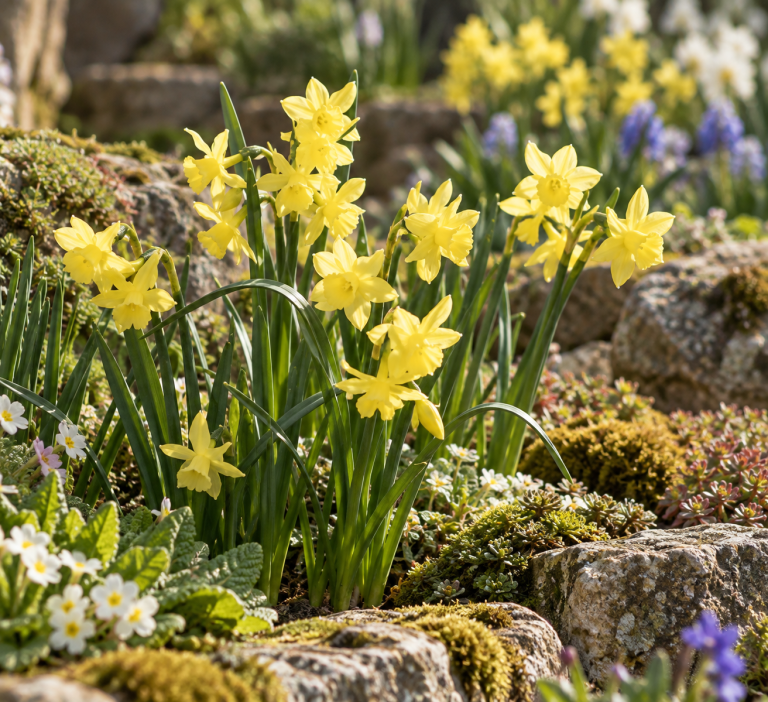
The Tenby Daffodil (Narcissus obvallaris) is a beautiful native Welsh wild daffodil, producing compact, rich golden-yellow flowers in early spring.
Traditionally associated with Pembrokeshire and the Tenby area, it is ideal for naturalising through grass, beneath deciduous trees and along woodland edges. Its early flowers also provide useful additional forage at a time when relatively few plants are in bloom.
Joel says…
“This is exactly the sort of bulb I love to see naturalised rather than planted formally. Put them through grass or beneath deciduous trees in loose groups, leave the foliage alone after flowering, and let the colony develop naturally over the years.”
🪴 Supplied as quality bulbs ready for autumn planting. More important info below:
From £3.95
The Tenby Daffodil (Narcissus obvallaris) is one of Britain's most distinctive wild daffodils - a compact, beautifully proportioned spring bulb traditionally associated with south-west Wales and particularly the Tenby area of Pembrokeshire.
Unlike many larger cultivated daffodils, the Tenby Daffodil has a wonderfully simple wild character. Its flowers are a rich, uniform golden yellow, carried above relatively short, sturdy stems, creating bright pools of colour in early spring.
It is particularly lovely planted informally through grass, beneath deciduous trees, along woodland edges or in naturalistic spring borders, where established bulbs can gradually build into colonies.
The Tenby Daffodil has a fascinating botanical history, having variously been treated as a species in its own right and as a subspecies or form within the wider wild-daffodil group. Kew specifically records the name Narcissus obvallaris in connection with the Tenby Daffodil of Wales.
Wildlife value
Early spring flowers can be particularly useful in a wildlife garden because relatively few plants are flowering when insects first become active.
The open flowers of the Tenby Daffodil can provide additional early-season pollen and nectar for visiting insects, including early-emerging bees.
But its importance in a WYG garden goes beyond simply providing forage. This is a British native wildflower with a genuine relationship to our landscape and botanical heritage, rather than an ornamental daffodil selected solely for garden appearance.
Plant it alongside other native spring flowers to help create a more diverse succession of early-season flowering plants.
Planting & care
Position: Sun or partial shade
Soil: Moist but well-drained soil; avoid permanently waterlogged ground
Planting depth: Around 10-15cm deep, or approximately 2-3 times the depth of the bulb
Spacing: Approximately 8-12cm apart, or plant more loosely for a natural effect
Height: Approximately 20-30cm
Flowering: Early spring, typically February-March
Aftercare: Allow the leaves to yellow and die back naturally after flowering. Avoid cutting or tying the foliage while still green, as it is replenishing the bulb for the following year's flowers.
For naturalistic planting, avoid regimented rows. Scatter the bulbs gently across the planting area and plant them roughly where they fall, varying the spacing slightly.
They can look particularly beautiful naturalised through grass or beneath deciduous trees, where they flower before the tree canopy fully develops.
A Welsh botanical treasure
The Tenby Daffodil has long been associated with Wales and is particularly connected with Pembrokeshire.
Its precise botanical classification has changed over time - something that isn't unusual within the complicated Narcissus family - and you may encounter it under several botanical treatments.
The familiar name Narcissus obvallaris, however, remains strongly associated horticulturally and botanically with the Tenby Daffodil, while British botanical records have also treated it as Narcissus pseudonarcissus subsp. obvallaris.
That history makes it a particularly lovely choice for gardeners wanting to grow something with a genuine connection to the wild flora and cultural landscape of Britain.
SAFETY NOTE
Daffodils are toxic if eaten. Bulbs and other plant parts should not be consumed and should be kept away from children and pets likely to ingest them.
Daffodil sap can also cause skin irritation in some people, so gloves are sensible when handling larger quantities of bulbs.
Why Wild Your Garden?
We carefully select bulbs that earn their place in a wildlife-friendly garden - prioritising native and naturalised species where ecological relationships matter most, alongside carefully chosen ornamentals that provide useful additional forage.
Orders are hand-picked for quality and packed in paper wherever suitable, with breathable net packaging used where necessary to keep bulbs in the best possible condition.
We work with specialist bulb growers and suppliers, including long-established local growers.
Additional information
| Bulb Quantity | 10 Bulbs, 15 Bulbs, 25 Bulbs, 5 Bulbs |
|---|
You May Also Like
Select options This product has multiple variants. The options may be chosen on the product page
Select options This product has multiple variants. The options may be chosen on the product page
Select options This product has multiple variants. The options may be chosen on the product page
Select options This product has multiple variants. The options may be chosen on the product page
Select options This product has multiple variants. The options may be chosen on the product page
Select options This product has multiple variants. The options may be chosen on the product page
Select options This product has multiple variants. The options may be chosen on the product page
Select options This product has multiple variants. The options may be chosen on the product page
Select options This product has multiple variants. The options may be chosen on the product page
Select options This product has multiple variants. The options may be chosen on the product page

Select options This product has multiple variants. The options may be chosen on the product page

Select options This product has multiple variants. The options may be chosen on the product page
Subscribe to our mailing list
Enter your email address to sign up to our newsletter and receive our latest offers and new releases!

© 2023 Wild Your Garden Ltd. All Rights Reserved. Registered in England and Wales. Company No. 12995106.
Opening Hours
Customer Service Team available:
Monday – Friday – 09:30-16:30
Saturday & Sunday – Closed
Bank Holidays – Closed
Our Christmas opening hours are normal opening times on all dates except Bank Holidays when we will be closed.